
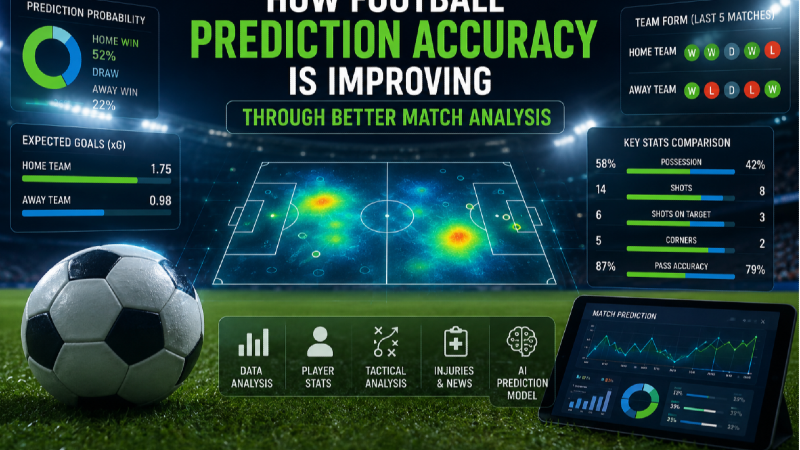
Ways to Increase Predictive Accuracy of Football Matches Due to Match Analysis
Ways to Increase Predictive Accuracy of Football Matches Due to Match Analysis
There are numerous changes in the nature of football predictions. Back then, predictions were mainly based on reputation, results and statistics of head-to-head matches of the teams. However, nowadays match analysis is much more complex. There are many factors that analysts can consider before making a prediction. For example, goals, xG, shots, possession and other factors.
Nevertheless, this does not mean that football matches can become predictable. On the contrary, this sport is unpredictable. Red cards, penalties, injuries, brilliant individual plays can change the result of the game. But thanks to more sophisticated match analysis, the predictions can become more accurate.
Football fans who are interested in match analysis can use such websites as VerifiedPredict.com to analyze predictions and compare various aspects of the match.
Match Analysis in Football
Match analysis in football is a process of analyzing various data of two teams participating in a match.
Analysts do not ask a question "which team is stronger?". Instead, they try to answer to such questions and many other ones:
- How have these teams been playing recently?
- How many opportunities to score did they generate?
- How many opportunities to score did they concede?
- Are they stronger at home or away?
- Which team is lacking key players?
- What tactics are they likely to use?
- How strong are their opponents?
- Are their recent results better or worse than their performance?
Thanks to these and other questions, analysts receive additional information about what can happen during the match.
How Better Data Is Helping to Improve Football Predictions
One of the main changes in football predictions is improved access to the data.
Each football match generates many data points. For example, shots, passes, tackles, possession, shots location, opportunities to score, players' actions and many other things.
Nowadays, predictive models are able to use all this data rather than just the scores of the matches.
According to the study conducted by PLOS ONE, xG (expected goals) is more effective for the future performance prediction than goals and shots statistics in traditional football predictions.
It is important because the scores do not tell the whole truth.
For example, one team lost 1-0 despite generating several good opportunities to score. The other team won 1-0 but did not generate many scoring opportunities. Just looking at the scores will not give the right picture while the analysis will do it.
The Importance of Expected Goals (xG)
Expected goals or xG has become one of the most important statistics in modern football analysis.
In simple words, the xG statistic analyzes the quality of scoring opportunities. The probability is calculated for each opportunity taking into consideration many factors like distance, type of the chance and other variables.
For example, the close-range chance in front of an empty goal will have much higher xG probability than the long-range shot from a difficult angle.
Thanks to this statistic, the analysts can estimate how good the teams are at generating or conceding chances.
The team that consistently generates high xG opportunities will be generating great chances to score even without scoring many goals recently. This information will be useful for future predictions.
Team Form Is More Than Winning and Losing
Team form is important but the match analysis today takes into account many more factors than just winning and losing.
For example, Team A has won 4 out of its last 5 matches. It looks pretty good at first sight. But what if 3 out of 4 wins were earned against significantly weaker teams.
On the other hand, Team B has lost 2 out of its last 5 matches, but had to face 3 of the best teams in the league and generated more scoring chances than the results show.
That is why modern analysts try to combine the results and performance statistics rather than to look at the form table only.
Home and Away Performance
Location of the match can also influence the accuracy of the predictions.
Some teams are very strong at home and weak in away matches while other teams play well in both cases.
Therefore, good match analysis takes into account:
Home team's home performance VS
Away team's away performance
Also, the analysts can consider such performance indicators as goals scored/conceded, xG, xGA, shots and many other statistics in this case.
Thanks to this, analysts can find patterns that are impossible to find with general team statistics.
Player Injuries and Suspensions
Team statistics are important but football is played by the players.
The injuries or suspensions of the key players like strikers, goalkeepers, central defenders or playmaking midfielders can greatly influence the performance of the whole team.
That is why modern match analysis also considers this factor before making the predictions. Some systems even adjust the team strength according to the availability of the players.
This is especially true before the match because any injury/suspension can greatly influence the predicted outcome.
Tactical Analysis Helps to Make Better Predictions
Statistics cannot tell the whole story about the match.
Two teams can have the same statistics but use different strategies.
One team may prefer possession and short passing while another one relies on counter-attacks. One team that has problems with high pressure can have difficulties with such an opponent while another one feels comfortable under the pressure.
Therefore, the tactical analysis helps the analysts to understand the reasons of the statistics.
For example, one team has less possession but creates great opportunities to launch a counter-attack. Possession statistics alone can make this team look weaker while the situation can be much more complicated.
Artificial Intelligence and Prediction Models
Artificial intelligence and statistical models are changing the process of football prediction too.
Instead of analyzing thousands of matches manually, models are able to process tons of data using computer programs.
These models are able to analyze various patterns related to:
- Team strength
- Recent form
- xG
- Goals scored/conceded
- Home advantage
- Player availability
- Previous performance
- League strength
- Tactics and many other indicators
Modern systems can even use multiple models rather than relying on one prediction model. This can help to minimize the influence of any possible weakness of one particular model.
However, AI cannot make football predictable. The quality of the prediction depends on the quality of the data and model itself.
Why the Predictive Accuracy Cannot Be Improved Without Limits
Despite the efforts to collect more and more data, the prediction cannot eliminate the unpredictability of football.
While prediction can indicate that one team is more likely to win, it does not mean that this victory will be achieved.
The small number of goals in football compared to other sports makes the single event influential enough to determine the match outcome. Researchers also point to the difficulty of drawing predictions accurately.
That is why a good prediction should be considered as probability and not as guarantee.
The goal of the prediction is not to predict every match. The goal is to make an informed decision with the help of better data.
How to Use Better Match Analysis
Football fans can improve their analysis using simple steps.
First of all, the recent form of both teams should be checked.
Then, home and away performance should be checked.
After that, goals and xG should be analyzed in order to evaluate the quality of scoring chances.
Next, injuries, suspensions and expected lineups should be examined.
Then, tactics of both teams should be analyzed in order to find out if one tactic causes difficulties for the opponent.
Finally, multiple factors should be compared instead of letting one statistic decide the result.
This approach will help to structure the process of football prediction and to decrease its dependence on emotions.
VerificationPredict.com can be used as the source of football prediction information to be compared with match analysis.
The Future of Football Prediction
The football prediction is going to become more data-driven in the future.
Improved tracking technology, bigger databases, advanced AI models and more detailed data about the players are going to provide more data for the analysts to work with.
However, the greatest progress in the future can be brought not by the collection of new data. It can be brought by the understanding which data is valuable and how it should be combined.
Models also need to be tested against the real results. A transparent prediction system allows recording previous predictions and comparing them with the real result in order to see the strengths and weaknesses of the prediction methodology.
Thus, the prediction process becomes a continuous process of learning.
FAQ
Is football prediction becoming more accurate?
Yes, better data and match analysis are helping the analysts to make more informed predictions. However, no system can guarantee the accuracy since football remains unpredictable.
What is the most important statistic in football predictions?
There is no statistic that can predict every match. xG is a very useful statistic because it shows the quality of scoring opportunities but it works best when used together with other data like form, home/away records, player availability, etc.
Does team form matter?
Yes, but it should be analyzed not only by the wins and losses. The quality of the opponents and performance should also be taken into account.
Can the AI predict football matches perfectly?
No. AI is able to process big amounts of data and find the patterns in it. However, it cannot know exactly what is going to happen during the match.
How can I improve my football predictions?
Use multiple sources of information. Analyze form, xG, home/away records, injuries, tactics, team strength and performance instead of relying on one statistic.
Conclusion
Predictive accuracy of football matches is being improved due to match analysis. Analysts have access to much more data these days than just wins, losses and goals.
The expected goals, player availability, tactics, home/away records, advanced statistics and AI models can provide useful data before the match.
Nevertheless, better match analysis does not mean perfect prediction. Football will remain unpredictable. The best strategy is to use the data to estimate probabilities instead of treating any prediction as guaranteed.
As football is becoming more data-driven, websites like VerifiedPredict.com can help football fans to find and compare prediction data with their own analysis.
The future of football prediction is not about removing the unpredictability. It is about the better understanding of the game and the informed predictions.