
The Truth About Win Draw Win Predictions
Introduction
Win Draw Win (1X2) is among the most ancient and the easiest markets in football betting: bet either home, transparent, or away. That is what makes it so easy to tempt both novice and experienced bettors. But what is the practicality of these predictions? What are the statistics on accuracy, value and long term profitability? We burrow in evidence based insights, hacks that work, and traps, therefore, you will make wiser decisions when 1X2 predictions are applied in this article.
What exactly is a Win Draw Win prediction?
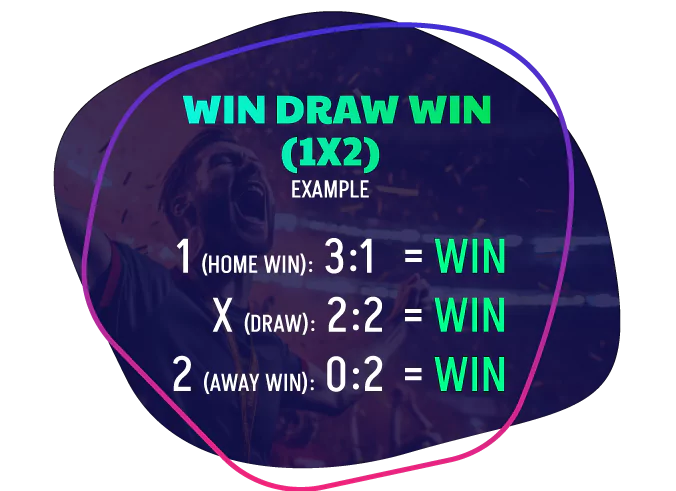
A Win Draw Win bet, also commonly referred to as 1X2, requires a punter to bet on whether or not the home team will win (1), game will be a draw (X), or that the away team will win (2). These outcomes are then priced by the bookmakers as odds and it is then up to the bettors to compare odds with their own estimation (or tipsters) to determine whether a bet is worth making.
What the data shows about accuracy
When statisticians examine extensive data sets of matches to measure how close any Accurate football prediction can come to real outcomes, there are a small number of visible patterns:
- Home advantage is real but shrinking. Historically, home teams were more successful compared to the off teams. Home wins vary depending on the league and time; it is about 45% to 50% of matches, draws about 25% to 30% and away wins 25% to 30%. Nonetheless, home advantage in most of the competitions has been dwindled over the past years through traveling, better facilities and change in tactics.
- Draws are hardest to predict. The draws are usually concentrated at certain percentages within the leagues. Due to the fewer occurrences and the tendency to be dependent on the course of the match (red card, injury time, defensive strategy) it is hard to anticipate the draws with constant precision.
- Market odds are efficient for favourites. Big data The odds of favourites provide a good price: the odds imply a high probability which is close to the actual performance of a strong favourite. Underdogs and long odds are less accurate in the market.
- Tipster accuracy often looks good on small samples. A predictor who makes a dozen posts with high accuracy might be enjoying a variance. Reliability manifests itself in long term performance (hundreds or thousands of picks).
Value vs Accuracy
The accuracy (relative frequency of a prediction being accurate) is distinct from the value (are the odds provided greater than the actual probability). A system that predicts correctly half of the results but only where odds suggest the possibility of 70% is losing value. Effective betting is about value identification – occasions when the probability that is estimated by the bettor is greater than the one that is suggested by the market odds.
Typical biases of Win Draw Win predictions.
- Recency bias: When one overweights recent data, one will be over reacting to one win or one loss.
- Confirmation bias: Only remembering what works and forgetting what does not.
- Excessive focus on superficial statistics: Goals scored or conceded are important, yet circumstances (injuries, motivation, travel) tend to modify the forecasted value.
- Ignoring draw probability: Betting may often neglect the presence of draw probability, and then rather consider win/lose and misprice draws which can in fact have hidden value when approached in the right manner.
How to evaluate a Win Draw Win tipster or model
When looking out for a tipster or a predictive model always check for the following:
- Sample size: To get a real tipster you need hundreds of bets and not just a single bet to actually qualify the person.
- Return on investment (ROI): Track the ROI or yield rather than just the raw accuracy.
- Bankroll tests: Simulate bets with realistic stakes to see if the strategy will survive a losing streak.
- Consistency across tournaments and seasons: A method that works just in one niche may not work in other leagues.
- Transparency: A trustworthy source always publishes full records, stake sizes and outcomes for a long time.
Practical strategies for bettors
- Use probability and not certainty. Convert odds to implied probabilities and compare with your model.
- Value hunting: Only bet when your probability percentage exceeds the implied probability by a margin that covers the bookie margin and staking strategy.
- Diversify markets: Consider double chance or draw no bet where appropriate because they reduce risk most of the time.
- Small stakes accumulate steady growth: Favor staking methods like flat stakes or Kelly fraction to protect bankroll.
- Keep a betting log: Record every bet, odds, stake, result, and rationale – this is how you learn.
The role of statistical models
Contemporary models make use of Poisson distributions, Elo ratings, machine learning and many more. These models can outperform intuition but are only as good as their input data and feature engineering. Key model pitfalls:
- Overfitting: A model that nails history may fail in new data.
- Poor features: Missing variables such as the team motivation or weather condition data can also skew probabilities (%).
- Ignore bookmaker limits: Even when a model is as good as, it will be challenged by odds limits and evolving markets as well.
Case study summary
Assume there is a dataset of 5,000 matches and implied market probabilities indicate that there are 48, 28 and 24 home wins, draws, and away wins, respectively. Assuming our model predicts home wins in the 52-percent range on a sub-set of games, the variation can generate profitable bets – assuming that the sample does not change, and the market does not adapt. This underscores the importance of constant checking and adjusting.
FAQs
Are Win Draw Win predictions profitable in the long run?
This can be true, but should their value be found on a regular basis and the bankroll and stakes wagered and handled in a reasonable manner. Raw accuracy in itself is not profit.
Is it better to bet on favourites than underdogs?
There is no inherent advantage of either. Favourites are generally efficiently priced; underdogs are good sometimes but risky. What counts more than team labels is your edge.
How many matches do I need to judge a tipster?
Preferably hundreds. Small samples are also prone to heavy variance and are usually misleading.
Should I use statistical models or follow predictors?
Both have advantages and disadvantages. The models are consistent; the tipsters can implement qualitative information. Better results are achieved by combining the two and confirming them with data.
Can I rely on public prediction sites?
Public sites such as soccervista are helpful in research but exercise caution: most of them publish nice short-term records which fail. Checking using full historical results is always necessary.
Conclusion
Win Draw Win predictions are predictions that are easy to formulate and difficult to execute. Statistics indicate that the market is efficient in most aspects, particularly where favourites are involved, whereas draws and long-priced results can cover an opportunity. Long term success requires concentration on value, not raw accuracy, on big samples to prove the strategies are good and bankroll discipline. When you treat 1X2 markets with patience, good analytics and a sense of humility regarding variation, you will be in a much better position than gamblers who are pursuing sure predictions.